Fluxlock Protocol v1.0
Identity IsContinuity
A continuity-based adaptive identity protocol designed to preserve trust through key rotation, cryptographic evolution, recovery, and long-term identity persistence.
Identity Is NotA Credential
Traditional Systems
Credential ownership becomes identity.
Fluxlock
Credentials become evidence of identity.
Static Identity Is Fragile
Password Theft
Once stolen, ownership often becomes indistinguishable from identity.
Key Compromise
Traditional systems bind identity directly to one credential.
Quantum Risk
Harvest-now decrypt-later attacks threaten long-lived cryptographic trust.
One Lock. Many Keys.
Key Rotation
Credentials evolve without losing identity continuity.
Trust History
Trust accumulates through time, lineage, and behavior.
Recovery
Compromise becomes survivable without destroying identity.
Identity Through Continuity
Identity ThroughContinuity
Identity remains stable while credentials, governance, validators, recovery mechanisms, and cryptography evolve around it.
Identity
Persistent Core
Active Continuity Event
RSA
Post-Quantum Ready
Fluxlock separates identity from any single cryptographic algorithm. If cryptography changes, identity continuity remains intact.
Algorithms Change.Identity Survives.
Cryptography evolves. Trust continuity remains.
AI Identity Continuity
Future autonomous systems may require persistent identity across upgrades, migrations, retraining events, and evolving cryptographic foundations. Fluxlock introduces continuity as a protocol-level identity primitive.
Continuity Network
Identity exists at the center. Credentials evolve around it. Fluxlock separates ownership, trust, recovery, lineage, and cryptographic evolution into a continuity network.
Protocol Visualizations
Fluxlock is more than authentication. It is a living continuity network where trust, lineage, authority, governance, and validator consensus evolve together across time.
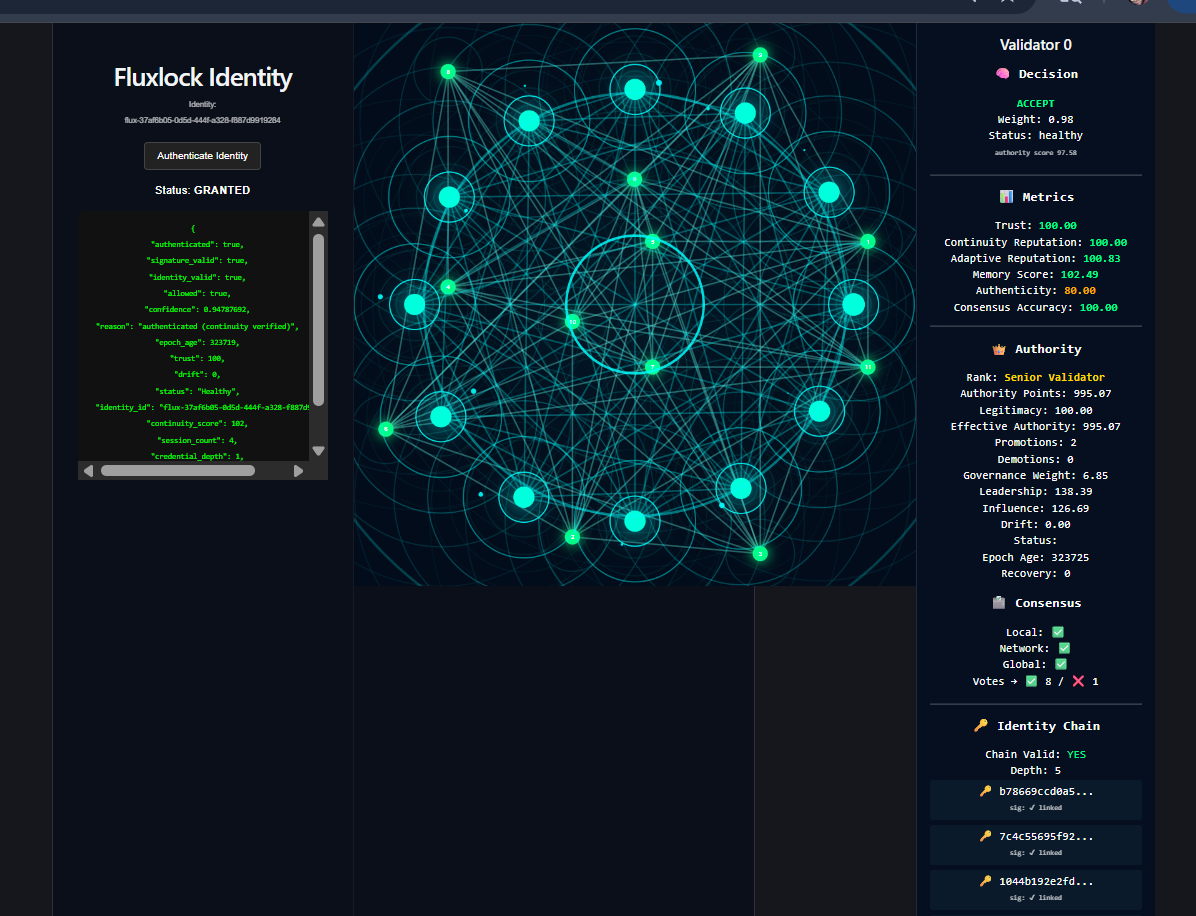
Continuity Mesh
Identity exists within a continuity mesh where validators preserve trust through lineage, memory, recovery, and cryptographic evolution.
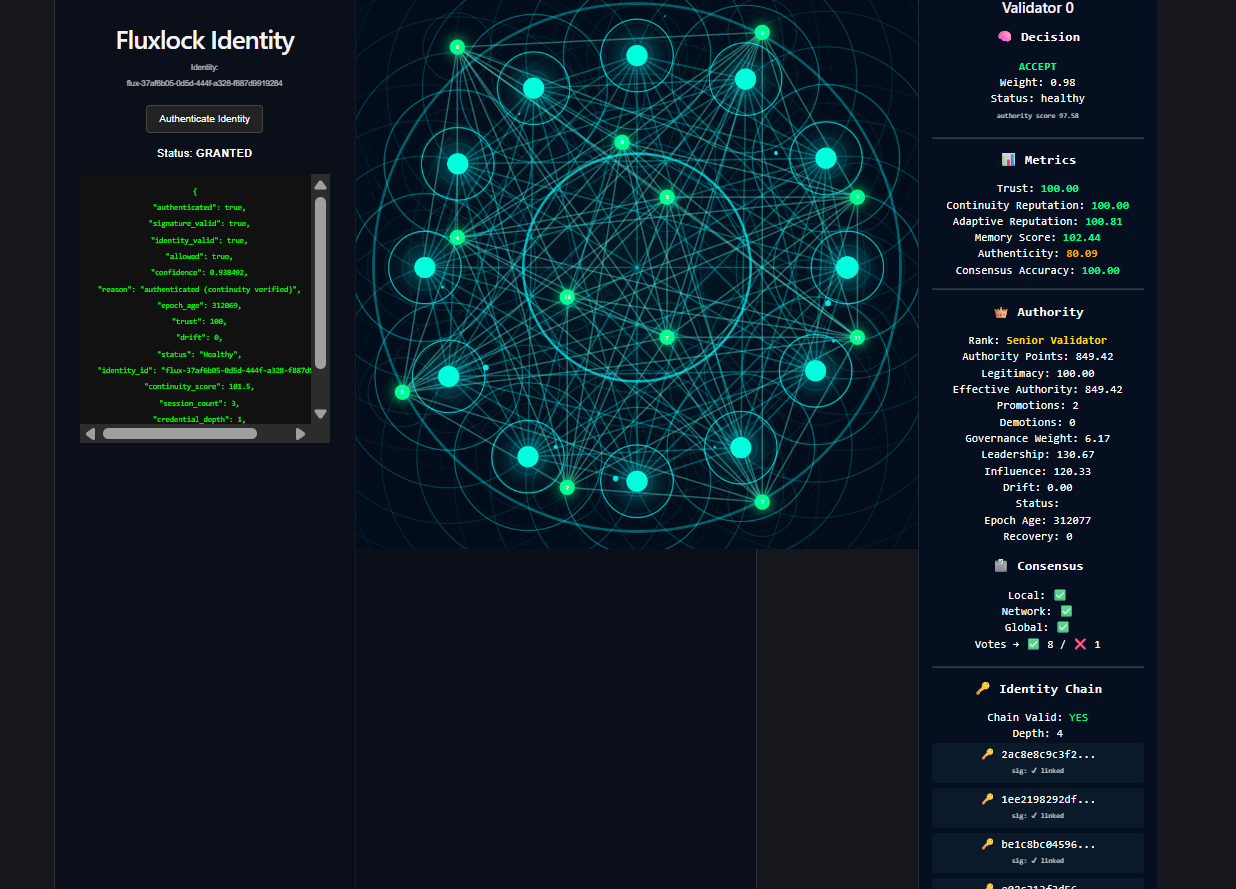
Authority Network
Authority emerges through continuity, legitimacy, governance participation, and validator consensus.
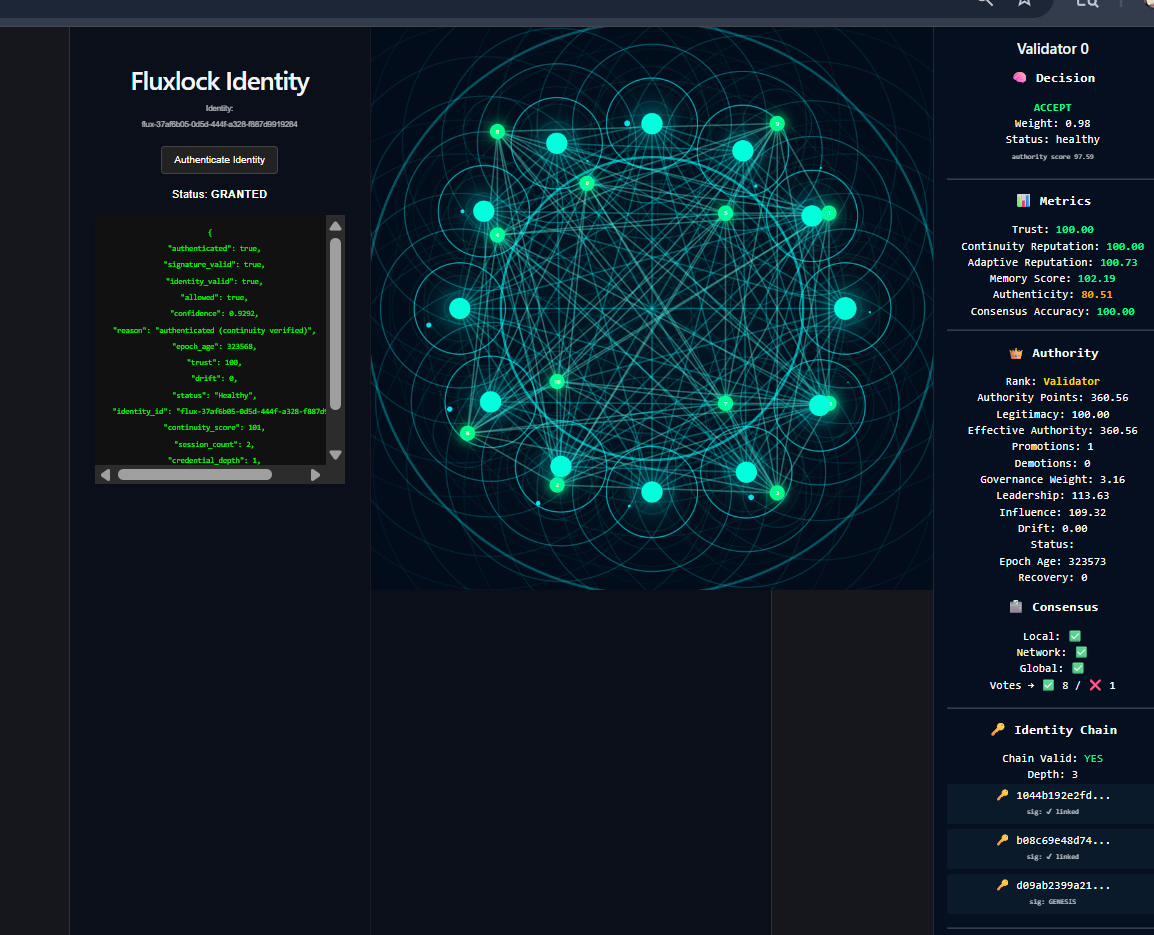
Validator Topology
Validators form a distributed topology that evaluates trust, reputation, recovery performance, and continuity.
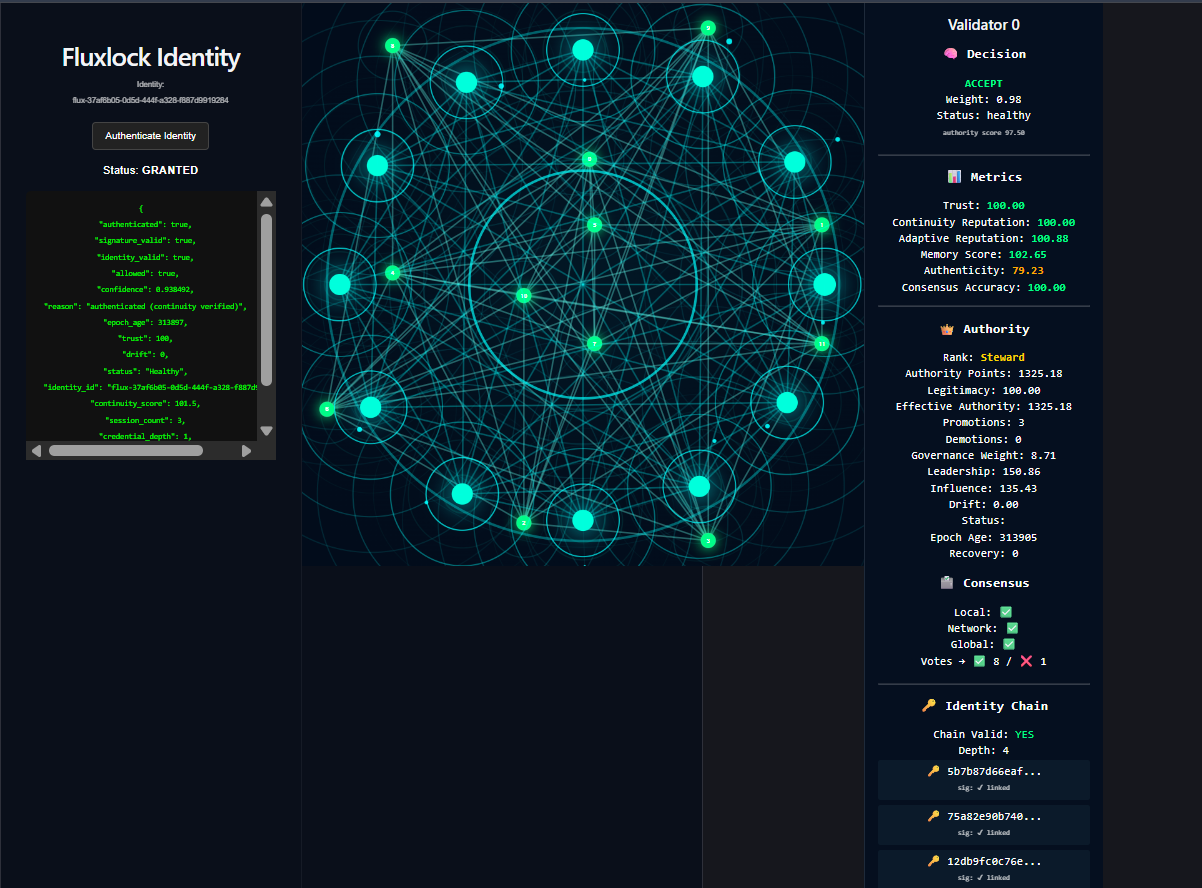
Identity Lineage
Identity survives evolution through lineage preservation, allowing trust to persist across key rotation, recovery, and cryptographic change.
How Fluxlock Works
Identity is not stored in a credential. Identity emerges through continuity across time.
Create Identity
Identity begins with an initial credential and continuity record.
Build Trust
Validators, history, and behavior accumulate continuity evidence.
Rotate Credentials
Keys may evolve without breaking identity.
Recover
Compromise becomes survivable through continuity verification.
Evolve
Identity survives future cryptographic migration.
Identity Epochs
Fluxlock allows identity to evolve through scheduled continuity epochs without losing trust.
Continuity Validators
Validators do not verify ownership. Validators verify continuity.
Lineage Verification
Recovery Verification
Epoch Verification
Trust Verification
Research Areas
Identity Continuity
Cryptographic Agility
Post-Quantum Migration
AI Agent Identity
Long-Lived Trust
Adaptive Governance
Protocol Architecture
Fluxlock separates identity into distinct layers that evolve independently while preserving trust.
Identity Core
Persistent identity independent of credentials.
Continuity Layer
Maintains lineage across key rotation and recovery.
Validator Network
Verifies continuity events and trust transitions.
Governance Layer
Coordinates protocol evolution and future epochs.
Cryptographic Layer
Supports current and future algorithms.
Fluxlock Roadmap
From protocol concept to continuity network.
Architecture
Development Activity
Public protocol development.
Current Release
Core Protocol
Source
Development
Validator Documentation
Verify
Validate continuity events.
Consensus
Participate in trust decisions.
Governance
Support future protocol evolution.
The Future of IdentityIs Continuity
Fluxlock separates identity from credentials and preserves trust through change.
Identity Has Been Ownership
Fluxlock proposes identity as continuity.
Traditional Identity
- • Single credential dependency
- • Key theft becomes identity theft
- • Algorithm replacement is disruptive
- • Recovery often destroys trust
Fluxlock Identity
- • Multiple credentials
- • Trust survives key rotation
- • Cryptographic agility
- • Recovery preserves lineage
Who Needs Continuity Identity?
Enterprise
Survive credential compromise.
AI Systems
Persistent agent identity.
Post-Quantum
Migrate algorithms without losing trust.
Critical Infrastructure
Long-lived operational identity.